Nodle and Paragon ID join forces to redefine what can be tracked
The promise of IoT connectivity has long been shaped by powerful infrastructure technologies such as cellular, WiFi, and LPWAN networks. While these solutions provide robust coverage and performance, their deployment and operating costs can limit large-scale, item-level tracking use cases.
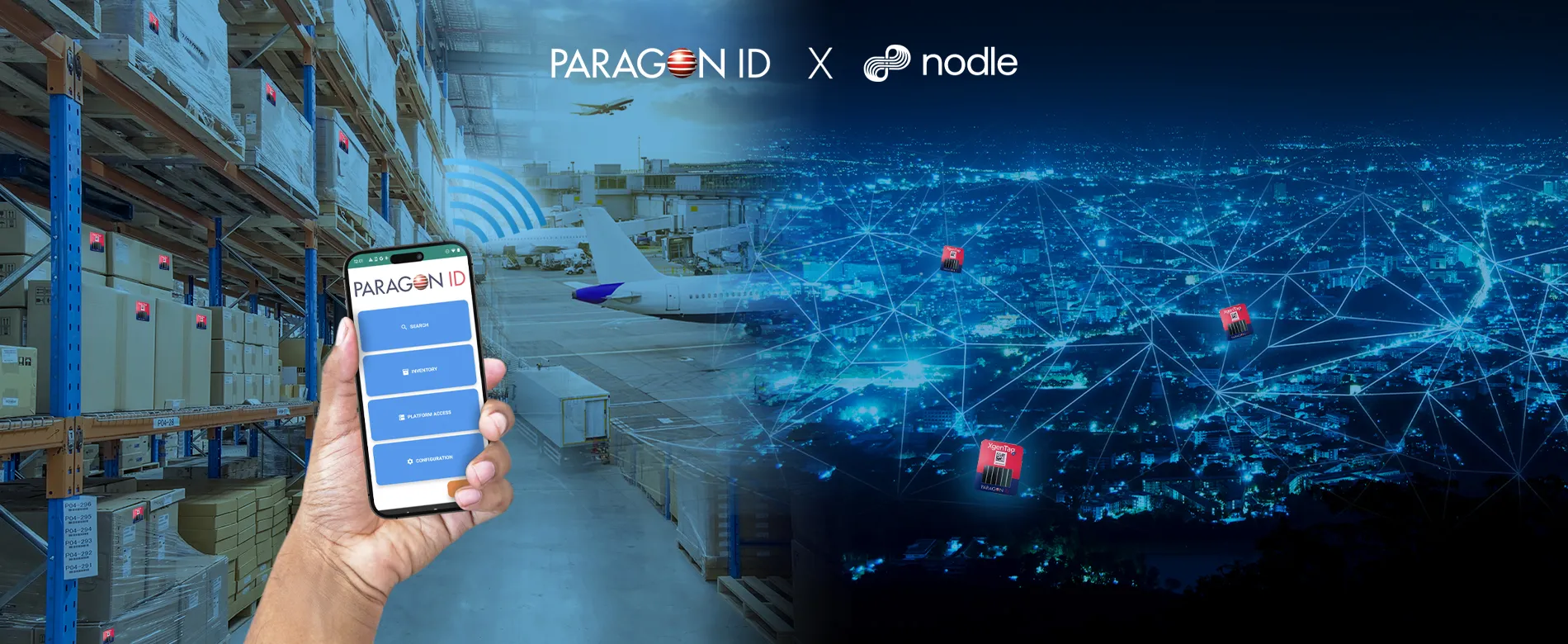
Nodle and Paragon ID are introducing a complementary approach that unlocks a new layer of IoT economics. By combining battery-free Bluetooth® Low Energy tags with a crowdsourced connectivity network powered by millions of smartphones, the two companies are enabling a new class of asset tracking and sensing solutions that are simple to deploy, maintenance-free, and economically viable at scale.
Paragon ID CEO, John Rogers, mentioned: “We believe the economics of object tracking are reaching a tipping point. By removing the need for batteries and fixed infrastructure, this approach makes it possible to deploy tracking at a scale that was not previously viable. Together with Nodle, we are enabling organisations to access richer, real-time data about their operations in a simple and cost-effective way.”
At the heart of this innovation is a simple idea: A low-cost, maintenance-free Bluetooth® tag, when combined with a widely available device such as a smartphone, can deliver reliable location and sensing capabilities without requiring dedicated infrastructure or cabling in most environments.
This fundamentally changes the economics of IoT deployment. Instead of requiring upfront investment in fixed readers, gateways, or connectivity contracts, organizations can leverage existing personnel devices to capture data across warehouses, factories, hospitals, or airports.
“In environments where smartphone coverage is limited or assets move beyond controlled areas, Nodle’s global crowdsourced network extends visibility far beyond site boundaries. This enables seamless transition from local detection to national or even global tracking, at a very low incremental cost,” says Micha Benoliel, Nodle CEO.
The partnership pairs Nodle's ConnectX platform with Paragon ID's battery-free Bluetooth® Low Energy tags, XgenTag, to deliver what networks based solutions have been struggling to deliver: global coverage without fixed infrastructure or networks, location and sensing data without power-hungry hardware, and per-unit costs low enough to make tracking practical for almost any physical asset and industry.
Early 2026, the two companies are running field trials in France, and other international locations, in a wide range of operational environments. The collaboration reflects a shared conviction that the economics of asset tracking are on the verge of a fundamental shift, and that we are entering an era of low-cost, information-rich IoT sensing available to any organization, anywhere in the world.
A Bluetooth® tag that lasts forever
Paragon ID has developed a portfolio of battery-free Bluetooth® LE (BLE) tags that remove power constraints and allow beacons to run nearly indefinitely, with zero maintenance. Paragon IDs XgenTag-L harvests ambient light through an organic photovoltaic surface, collecting sufficient power to transmit Bluetooth® LE signals as frequently as once per second under normal lighting conditions and working in almost complete darkness (from 5 lux onward). This beacon has a designed operational life of more than ten years and no battery to replace. The XgenTag-R draws energy from UHF RFID fields, activating within 20 meters of a standard reader, and is well suited to monitoring or tracking enclosed or non-visible assets. Together, the two beacons can be deployed across a wide range of use cases:
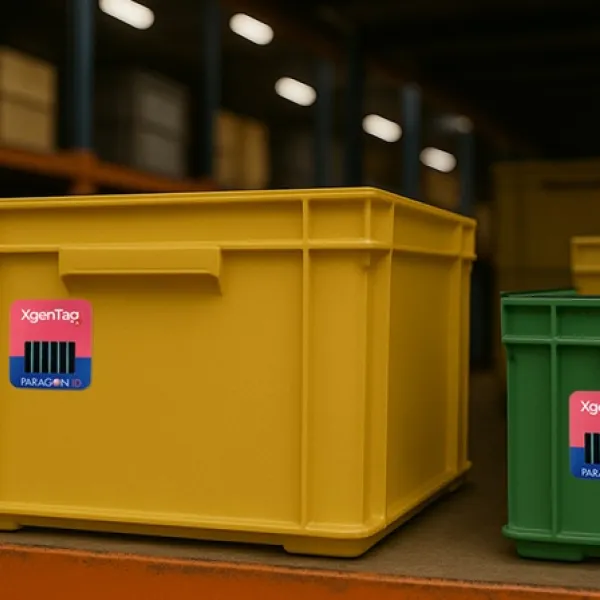
- Logistics and closed-loop returns: Pallets, shipping containers, roll cages, waste bins, kegs, and gas cylinders moving through return networks where assets spend long periods enclosed in trucks or stacked in depots.
- Healthcare: Surgical instrument trays cycling between sterilization and operating rooms, and pharmaceutical shipments where chain-of-custody documentation is a regulatory requirement.
- Construction: Scaffolding components and power tools on job sites, where high theft rates and dispersed locations make continuous visibility operationally valuable.
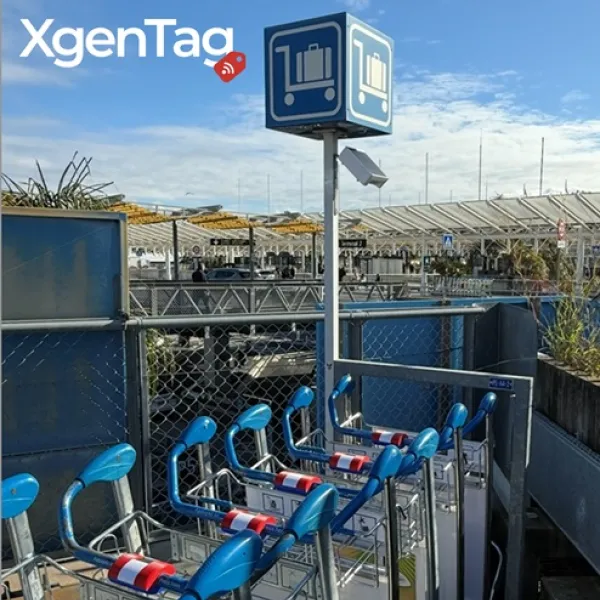
- Aviation and ground handling: Baggage carts and unit load devices on airport aprons, where assets move constantly across large outdoor environments with no fixed reader infrastructure.
What makes Paragon ID’s tags particularly compelling is their ability to combine location with simple sensing, such as temperature, in a compact, battery-free form factor. Until now, achieving this required complex, power-hungry hardware and dedicated connectivity. XgenTag changes that by enabling low-cost, maintenance-free deployment at scale, with hardware small enough to be attached to almost any asset.
The network that makes it work
A tag that broadcasts continuously is only as useful as the network available to receive its signal. Fixed Bluetooth® LE reader infrastructure works well in controlled environments but is expensive to deploy and poorly suited to assets that move across geographies. Cellular connectivity solves the coverage problem but reintroduces the cost and power considerations that battery-free hardware was designed to eliminate.
Nodle's ConnectX service takes a different approach. It harnesses a global network of millions of smartphones, as a passive relay layer for Bluetooth® LE signals. Smartphone owners participate in the Nodle network by running Nodle-enabled applications and earn NODL tokens in return, creating a self-sustaining, crowd-powered infrastructure that grows organically without any capital investment in fixed hardware. When a Paragon ID tag broadcasts, any nearby participating smartphone picks it up, captures the location derived from the phone's own geolocation data, and relays that information, including any sensor payload, back to the network.
Enterprises can easily integrate the Nodle ConnectX SDK with their own mobile applications, allowing them to create additional access points to the Nodle network wherever their own users are present. No dedicated infrastructure is required, and no cellular contract is attached to the tag. ConnectX is hardware-agnostic, built on the open Bluetooth® advertising packet standard, and designed to give enterprise customers full control over their data models and integration stack, which is particularly important for organizations navigating data sovereignty and privacy regulations.
Trials across three continents
The ongoing field trials are designed to test this combination across a range of real-world environments. In France, deployments have started at a logistics facility near Albi and at Nice Airport. In South America, a trial is ongoing at Santiago in Chile and Sao Paulo in Brazil. In Africa, tags will be deployed in multiple countries where the density of Nodle's user base offers an opportunity to measure network performance under demanding field conditions. Each site tests a distinct operational context, from industrial logistics to airport operations to vehicle tracking, across three very different geographies.
The world as a sensor network
Paragon ID brings deep expertise in traceability and system integration, along with an active deployment base across logistics, aviation, healthcare, and transportation. Nodle brings a proven global network and a platform built for exactly the kind of lightweight, low-cost, infrastructure-free connectivity this new generation of hardware demands. Together, we believe we are moving toward a world where information about the physical world is as accessible and abundant as information about the digital one, where any object in motion can report its location, condition, and history to the people who need to know, powered not by expensive private infrastructure but by the millions of people who carry smartphones every day. The trials beginning this year are a first step toward that vision, and we look forward to sharing what we learn.
To learn more about Nodle ConnectX and enterprise asset tracking, or to speak with our team about a deployment, visit nodle.com. To explore Paragon ID's XgenTag platform, visit paragon-id.com. Current Nodle network statistics are available at network.nodle.com .
About Nodle
Nodle (Intergalactic Labs Inc.) is a San Francisco-based company founded in 2017 by Micha Benoliel. Nodle operates the world's largest crowdsourced Bluetooth network, connecting IoT devices through millions of smartphones daily. Its ConnectX platform provides enterprises with infrastructure-free BLE asset tracking and sensing without cellular contracts or fixed reader hardware. Participants in the Nodle network can earn NODL, the network's native token, for providing connectivity. For more information, visit nodle.com.
About Paragon ID:
Paragon ID is a global leader in identification solutions for the e-ID, Transport & smart mobility, traceability and payment markets. Drawing on its expertise in RFID, NFC, IoT and mobile technologies, the company helps organisations create connected ecosystems that improve efficiency and the user experience across various sectors such as logistics, retail, industry, aviation and healthcare.
Paragon ID employs more than 900 people and operates from manufacturing facilities in Europe, the United States, and Australia close to its customers.
Paragon ID is owned by Grenadier Holdings (formerly Paragon Group), a privately owned business with a global presence in more than 30 countries
For more information, visit: paragon-id.com